

There are some screening questions that we ask all donors at each appointment and some that apply only to specific donations.
When you donate platelets, we ask if you have had your spleen removed (called a splenectomy). We don’t ask this for whole blood, plasma, or Super Reds donations.
If you have had a splenectomy and meet all other eligibility criteria, you can donate whole blood, plasma, or red cells with no additional considerations.
For platelets, it’s a little more complicated. There’s math involved.
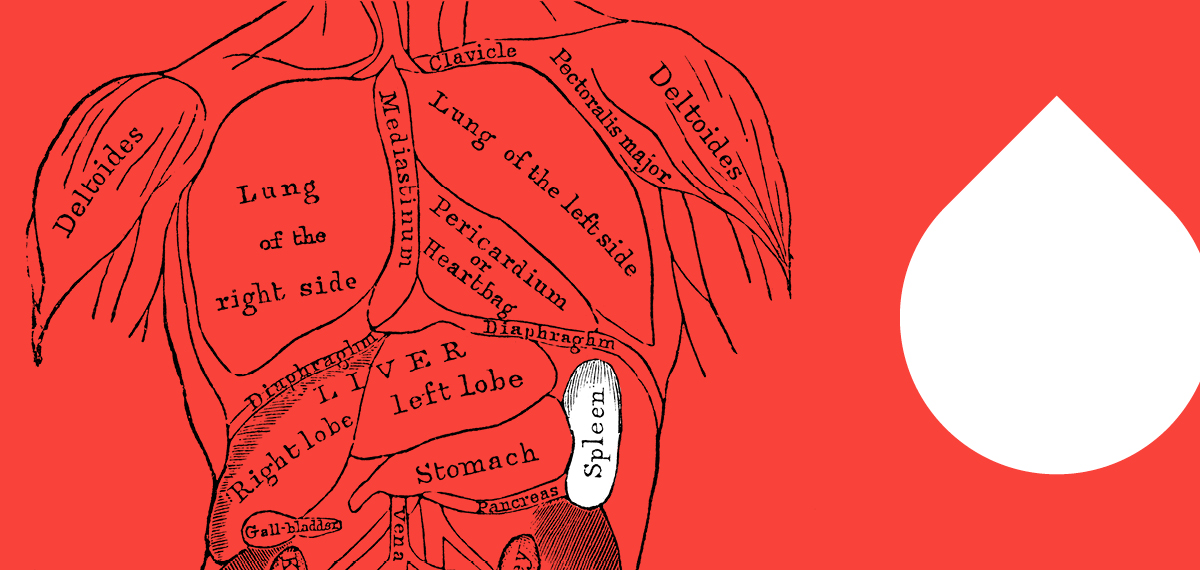
The spleen is an organ, located under your ribs to the left of your stomach, that plays an important role in your immune system. The spleen contains white blood cells that attack harmful pathogens and remove old or damaged blood cells from the bloodstream. It also acts as a reservoir for blood: 25-30% of red cells and 25% of platelets are stored in the spleen.
Unlike many other organs, you can live without a spleen, though you become more susceptible to certain infections and will need to take extra precautions to stay healthy. The liver and lymph nodes take over many of the spleen’s functions, and vigilance, vaccines, and antibiotics often cover the rest.
And, unlike any other organ, spleens can regenerate – when injured, spleen cells can disperse across the abdomen and grow into additional accessory spleens if they land somewhere favorable. This is more common than you would think: approximately 1 in 5 people have accessory spleens!
The primary reasons for splenectomy are trauma, cancer, and blood disorders, especially an autoimmune condition called Immune Thrombocytopenic Purpura (ITP).
Despite its location behind the protective covering of the ribs, the spleen is the organ most likely to cause life-threatening internal bleeding, especially after blunt trauma like a car accident or a contact sports injury. In the most severe cases, the spleen may be removed.
A history of blood cancer or a bleeding disorder will disqualify you from donating blood, with or without your spleen, but other reasons alone do not.
Because of the spleen’s role in storing platelets, people with no spleen or hyposplenism (low spleen function) often have elevated platelet counts.
If a donor has had a splenectomy and meets our splenectomy-specific (and all other) eligibility requirements, we run a calculation that factors in their total blood volume (TBV), determined using weight, height, and gender, and their platelet count prior to donation.
It looks like this: Donor’s TBV x (Donor’s pre-donation platelet count – 100) x 1,000 x 1,000
If the number is lower than the designated threshold, they can donate platelets. If the number is too high, we ask these individuals to try a different donation.
Since splenectomy patients tend to have more platelets, wouldn’t they be the best platelet donors? Unfortunately, if the platelet count is too high, it exceeds the storage capacity of the bag, which hinders platelet function and survival — paradoxically, this results in an inferior transfusion!


Tell Us What You Think!