

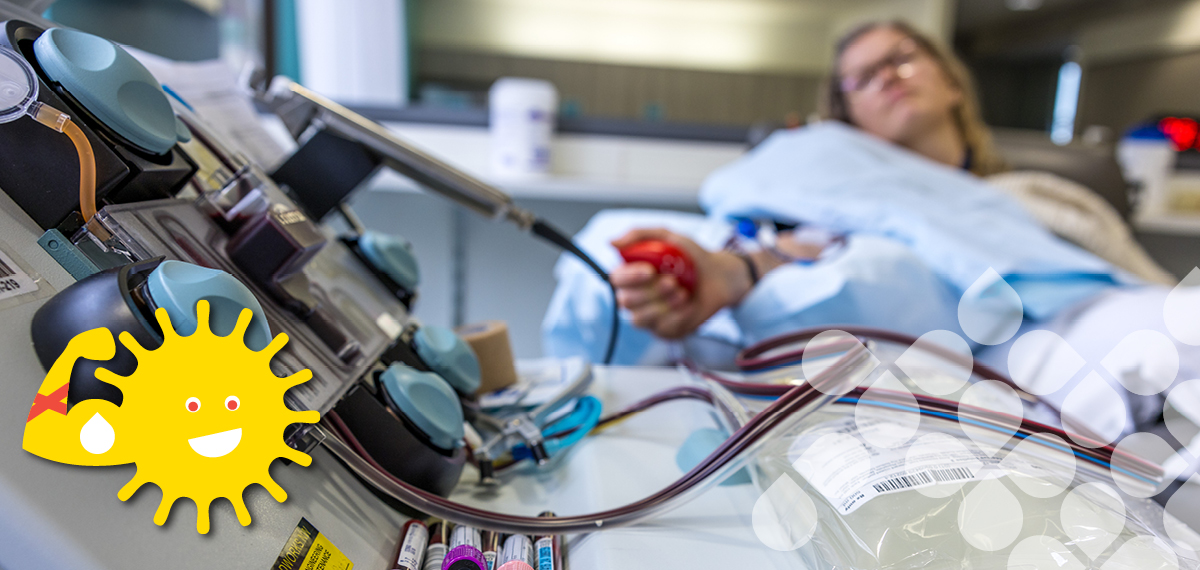
Do you get compliments on your veins when you donate blood? Do you have a couple of hours to sit back, relax, and save lives? You might be a great candidate for donating platelets!
Platelets play an important role in blood clotting and are one of the trickiest components to keep in our inventory: they have a shelf life of only 5-7 days, so it’s important to have a steady stream of platelet donors.
If you’ve always wanted to try donating platelets by apheresis but didn’t know where to start, it’s as easy as getting a platelet count.
Ask for a platelet sample at your next appointment! This is collected from the diversion pouch (the small sack that fills before the blood bag) during your blood donation along with the other tubes we send to our testing labs, no extra needles needed.
Want proof? Listen as Eller in our Vancouver Donor Center walks Skeptoid’s Brian Dunning through getting a platelet sample.
We track your platelet count in your Donor Portal account. Once you become a platelet donor, you’ll see a platelet count from each donation logged under Test Results.
Many routine physical exams include a Complete Blood Count (CBC), which measures the levels of different blood cells in your body, including platelets.
While this test is a great indicator of your platelet count (and good insight into your overall health), for regulatory reasons, Bloodworks can only accept the results of tests that we have administered. We will still need to perform our own platelet count for you.
Donor’s pre-donation platelet counts must be in the range of 150-600. Though we use three-digit numbers for platelet counts to keep it simple, this is actually 150,000-600,000 platelets per microliter (µL) of blood.
The upper value (600) is set by the apheresis machine, as it can’t verify leukoreduction (white cell removal) over that value. Removing white cells is important to reduce the chance of the recipient having a transfusion reaction.
Donors’ minimum post-donation platelet count can’t be below 100 for their own health, so a starting count of at least 150 is a regulatory requirement (and is the lower limit of the typical normal range). We don’t want to collect platelets from someone who is already having a problem with their platelets!
If a donor’s platelet count is above or below the 150-600 range, we notify them to let them know.
While you may receive this notice by email, platelet counts are personal health information (PHI), so our staff can only give the specifics over the phone.
A low platelet count from a sample is not necessarily cause for alarm – it can happen when platelets clot in the tube, an insufficient sample is collected, or even because of an issue with the sample tube itself.
If the donor’s count is above 600, we ask if they are aware of any conditions that might cause this, such as a splenectomy (removal of the spleen).
When either a high or low result happens, we ask that the donor come in to give another sample or to try again at their next whole blood donation.
If your platelet count remains outside of our acceptable range, we encourage you to talk to your doctor. Before returning to platelet donation, the Bloodworks medical staff will confirm that donating platelets is appropriate for you. One benefit of blood donation is that you can keep an eye on a few different aspects of your health!
Platelet donations can result in a single, double, or triple unit (one, two, or three transfusable units).
The multiple that a donor can give is determined by their platelet count and total blood volume (TBV), the amount of blood circulating in their body. Total blood volume is calculated based on height, weight, and gender – males tend to have a greater blood volume than females, even when a similar weight and height.
The greater the TBV and the higher the platelet count,the more platelets we can collect. So, a larger person could have a lower platelet count than a smaller person and be able to donate a greater yield.
Fun fact: our system uses the average of your last three platelet counts to estimate the platelet count value. You can go into your Donor Portal account and average your last three counts to see what this will be.
Schedule your next donation today – and ask for a platelet count when you come in! No matter your platelet count, platelet donation is another great opportunity to save lives (and comes with a few fun extras, courtesy of our Power Platelets Rewards Program).

Tell Us What You Think!