

As an employee of Bloodworks, I hear about the amazing work we accomplish all the time – and since I work in Fundraising, I’ve heard inspiring stories from every one of our programs and departments.
But after four years working here, I have to confess an embarrassing secret: I am a science ignoramus. I don’t know my flow cytometry from my mass spectrometry, and when pressed, I can only name five of the 47 different blood group systems.
I take comfort in knowing that some of our readers might feel the same. Maybe you, like me, love the idea of science and the outcomes of science but find it hard to keep your red blood cells separate from your platelets. (Thankfully, we have a cell sorter for that.)
Recently, the work of our amazing scientists has been threatened by NIH cuts, and so I set myself a task to better understand our Research Institute’s Principal Investigators (aka PIs) on a more human level. While I may never fully understand the amazing work they accomplish, I wanted to hear in their own words what this work means to them.
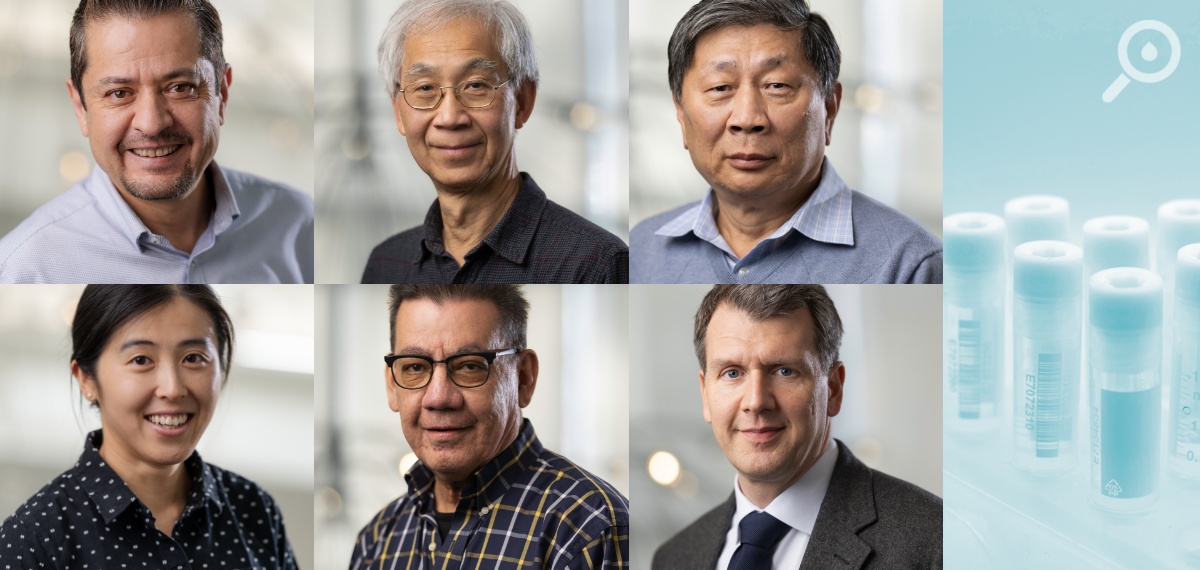
Thank you to Bloodworks Chief Scientific Officer Dr. José López, and Principal Investigators Drs. Raymond Adili, Dominic Chung, Jing-Fei Dong, Amily Guo, and Moritz Stolla for providing these insights into your journey and work.
Dr. Raymond Adili: The first time I fell in love with science was in medical school when I studied human biology. Conducting physiology experiments and seeing firsthand how the body functions fascinated me. Understanding complex processes, like blood circulation, made me appreciate the incredible intricacy of the human body. It was in those moments that I truly realized my passion for science.
Dr. Dominic Chung: High school. Eighth grade. Biology and chemistry.
Dr. Jing-Fei Dong: I was trained as a clinician but felt the need to learn about platelets after seeing many patients who failed cerebral vascular bypass after stroke because of vascular occlusion. Many of them were my patients.
Dr. Amily Guo: I’m not sure. Maybe the first-time seeing cancer cells under the microscope with molecular probes during medical school (a diagnostic test called FISH).
Dr. José López: As a kid, I was always in love with the natural world. I grew up on a farm/ranch in New Mexico and at the edge of a wilderness area. Every time I observed animals being born, growing, etc, I was fascinated. I remember in fourth grade reading about how scientists postulated a particle called a tachyon that could travel faster than the speed of light. I thought, “It must be so cool to be a scientist and be able to think about things like this.”
I thought, “It must be so cool to be a scientist and be able to think about things like this.”
Dr. Moritz Stolla: My interest in science started in high school. I wanted to start my first randomized clinical trial with my peers. This was obviously very naive, since I did not know anything about IRBs, INDs, etc., and luckily the pharmaceutical company did not respond to my request to provide placebos. In medical school and during doctoral thesis my mentor’s mantra was, “science is the best medicine.”
Adili: It took me 25 years to get where I am today. The greatest hurdle was securing a faculty position and setting up my own lab so I could focus on the science I’m passionate about. It was a challenging but rewarding journey, and finally being able to do what I love made it all worth it.
Chung: Over 20 years; the greatest hurdle was in crossing fields of study: thrombosis and lipoprotein metabolism.
Dong: 35 yrs, from clinician to an okay researcher.
Guo: Almost 20 years now. Being international, VISA issues have been the biggest hurdle.
López: I guess I would say it took about 30 years to fully develop. Greatest hurdle? Internal Medicine Internship at UW. It almost killed me.
Stolla: My pathway was very long. I had to combine my clinical training with research training and had to repeat some of my clinical training in the U.S. (I graduated from medical school in Munich, Germany). From the beginning of medical school until my first faculty appointment it was roughly 16 years. The biggest hurdle was to get the first grants and mold the lab that I inherited into my own.
Adili: The most recent time I felt absolutely in love with science was after I ran an experiment on sickle cell disease. I was able to visualize how different blood cells interact with one another in small blood vessels, leading to blockages that can cause complications like organ dysfunction. Seeing how these blood cell blockages disrupt normal circulation was both fascinating and eye-opening. This experience deepened my appreciation for research in hematology and disease pathology, reinforcing my passion for understanding and finding solutions to complex medical conditions.
Chung: Publishing the last paper that made the cover story of BLOOD in Nov 2024.
Dong: I get excited about science every time I work on a manuscript.
Guo: When exploring something new that worked. We recently collaborated with bioengineering scientists and measured mouse platelet contractile forces.
López: I feel this every time I contemplate a biological or chemical phenomenon that I don’t understand, which is every day.
Stolla: I like to observe clinical phenomena and then work backwards in the lab to solve puzzles and come up with potential pathophysiological explanations or therapeutical applications. We are currently trying to explain why some cold platelets form aggregates while others do not. We were able to support our hypothesis with data from mice in the lab.
Adili: I am one of the few well-trained researchers in my field of research due to my unique scientific background and training journey. Research truly is a lifelong pursuit—every discovery brings new questions and avenues to explore
Chung: Specialist.
Dong: Perhaps, the former [generalist] but it also depends on the specific project. My approach is to follow the data and my feelings. The latter is wrong most of time but get me somewhere more exciting.
Guo: I guess I follow the science. It’s not clear cut. Getting the problem solved is my focus.
López: I think I am more of a generalist, and that is because I get hooked into new scientific questions all the time. Being more of a generalist also keeps me from ever getting bored.
Stolla: Both, a generalist in my medical field (Transfusion Medicine) but a specialist in my research (Platelet transfusion and storage biology). I think you cannot know and learn everything. Therefore, it is a strength to combine specialties together and come up with a “research story.” These projects that combine different fields are often the most exciting ones.
Adili: Getting recognition of my research work by the American Heart Association.
Chung: Several months ago, we induced microvascular thrombosis in a mouse model of TTP (thrombotic thrombocytopenic purpura) and observe that injection of purified HDL completely prevented thrombosis in the small blood vessels.
Dong: Learn how to run a SDS and agarose gel (which separate proteins and DNAs) in a 4oC cold room (to avoid be seen as knowing nothing) more than 30 years ago.
López: These moments happen all the time. I mostly get my “a-ha!” moments vicariously because I do not work in the lab anymore, but people always show me cool data. One of the coolest recent findings is the observation (working with Raymond) that a molecule found in edible mushrooms can prevent the plugging of small blood vessels in mice with sickle cell disease.
Stolla: Without revealing too many secrets, in brief, we found a way to prevent aggregate formation and a decrease in platelet count in cold stored platelets.
Adili: I do basic translation cardiovascular research. The impact of our work is mostly indirect but very important. Some of my research findings result in new drug discover and new treatment for patients which feels great!
Chung: Since I am not a clinician, I have never interacted with any patient. Even when we work on their samples in the lab, their identity was not disclosed to protect their privacy as required by HIPPA regulations
Dong: Our research is more basic and translational, so it will take a long time to realize gains in a clinical setting. However, I was involved in several key clinical trials that have drastically improved clinical outcomes of patients (e.g., clopidogrel, aspirin-PC, verify now, enoxaparin, thrombin-based dressing for topical use of trauma).
López: Yes, and it felt wonderful.
Stolla: The Bloodworks Podcast recently had an episode that featured a very frequent platelet donor and a platelet transfusion recipient. It was very touching to see the dedication of the donor and the gratitude of the recipient, who survived leukemia in part thanks to frequent platelet transfusions. My basic bench work is rewarding, and providing “immediate curiosity gratification,” for example, with in vitro studies. However, with the translational licensing projects we run with companies and the clinical trials I run, I often have an immediate effect on the products that patients can receive in the clinic.
Adili: Research is an integral part of blood banks and patient services, playing a lifesaving and crucial role in advancing medical knowledge. By supporting research, we move closer to understanding and solving critical health challenges, ultimately improving patient care. Every bit of support, whether through donations, spreading awareness, or advocating for scientific funding, makes a significant difference.
Every bit of support, whether through donations, spreading awareness, or advocating for scientific funding, makes a significant difference.
Chung: Any form of donation will help the RI. Blood donations help directly patients who need blood or blood products. They also put Bloodworks in firm financial standing to support research in the RI. Follow Bloodworks’ podcast and spread the word.
Dong: Your support is critical in advancing biological and clinical know-how and to improve clinical delivery to patients.
López: I would say that we scientists are very passionate about what we do, motivated by our fascination, curiosity, and desire to help people. I would also say that the work we are doing is extremely important and likely to yield benefits, not only for the better understanding and use of blood, but also for a variety of diseases, some of which few people would think have to do with blood. I would ask that, if they can, they donate money to the effort. If they are unable to, they can let their elected representatives know about the importance of the work.
Stolla: Curiosity in general is a value on its own. I would rephrase the famous quote by the German artist Johann Beuys: “Everyone is an artist,” to “Everyone is a scientist.” You do not need to have millions in funding or even run your own lab. You can hypothesize and conduct experiments every day to test your hypothesis. I believe that in times where science is under attack, promoting curiosity and adhering to data instead of opinions is more important than ever before. In practical terms that means advocating for science, research, and federal funding even if you do not have the funds yourself to support the research institute.
Tell Us What You Think!