
Hanna, Bloodworks’ social media manager, recently had a conversation with her parents about her blood type.
Since Hanna’s mom is B+ and her dad is A+, how could she possibly be O+? Did she need to order a paternity test? Could she have been switched at birth?
Fortunately, there’s a very simple explanation.
Before we dig into how you inherit your blood type, let’s do a quick review of what blood types are.
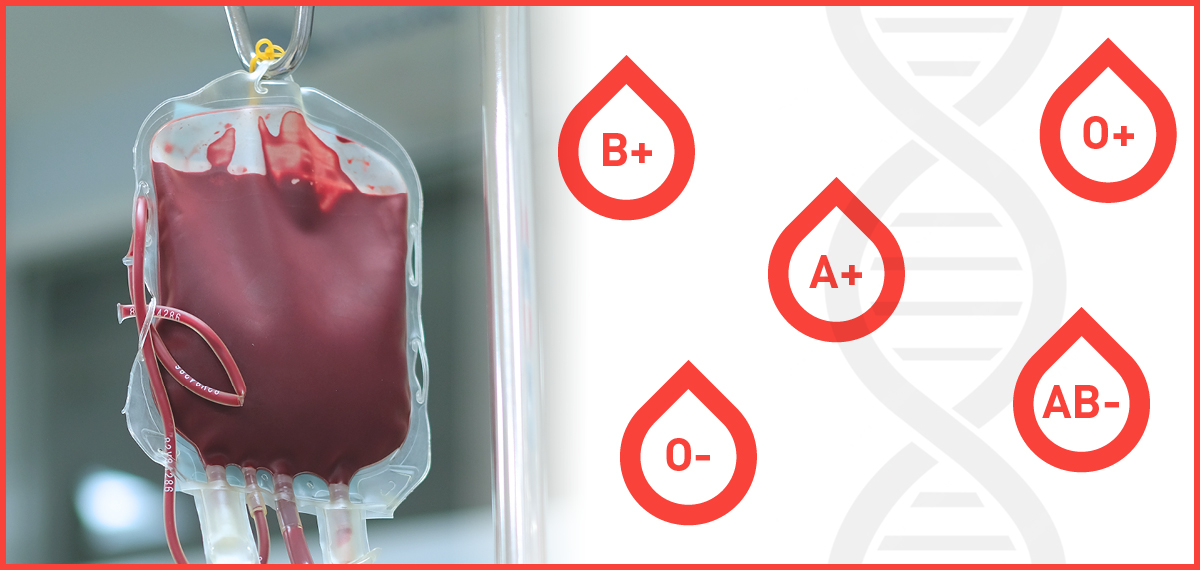
There are eight main blood types: A+, A-, B+, B-, O+, O-, AB+, and AB-.
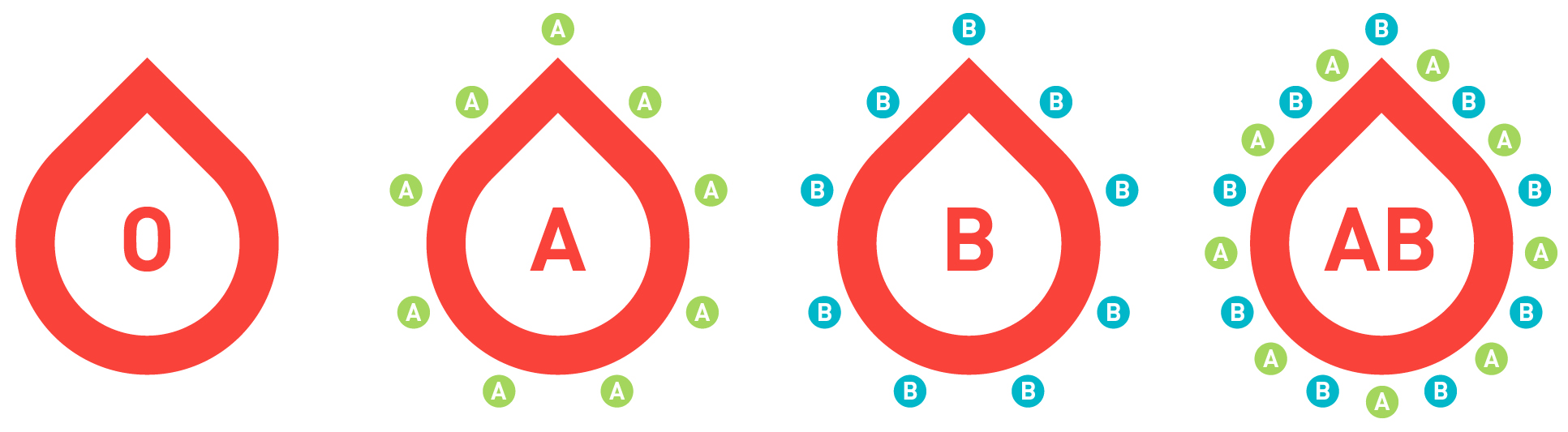
Blood types are an expression (or not) of markers on your red cells called antigens.
O is the base substance on which blood types are built on. Most people in the world have this (with very rare exceptions). A and B are antigens added on top of the O base to make those blood types.
Antigens help your immune system determine what is or isn’t part of your body. If your body doesn’t recognize a specific antigen as belonging to you, your immune system may fight it — this is why it’s so important for patients to receive matched blood.
ABO and Rh are the primary blood group considerations for most transfusions. However, ABO and Rh are just two blood groups out of nearly 50 identified by the International Society of Blood Transfusion!
Everything about you is inherited equally from your parents – each piece of your genetic code gets one allele (gene) from each parent.
Some genes are recessive, meaning they are only expressed if they are homozygous (both copies are the same). Blue eyes and attached earlobes are all examples of recessive genes.
Other genes are dominant, meaning there is no difference in expression between homozygous (both copies are the same) or heterozygous (both copies are different: one is dominant, and one is recessive) – the recessive gene is along for the ride. Brown eyes, detached earlobes, and freckles are all dominant traits.
The genes for A and B are co-dominant, meaning that both are expressed on blood cells.
People with blood type A could be genetically AA or AO, and people with blood type B could be genetically BB or BO. Those with blood group AB have both A and B genes (AB).
If no A or B genes are inherited (OO), the person will have blood type O.
Do you remember the Punnett’s square from biology class? It’s a simple diagram to predict which traits children will inherit from their parents based on the parents’ genotypes: the genes they carry (as opposed to phenotype: what shows up).
Because Hanna has Type O blood, her parents must each be heterozygous: Hanna’s father is blood group A (AO) and her mother is blood group B (BO).
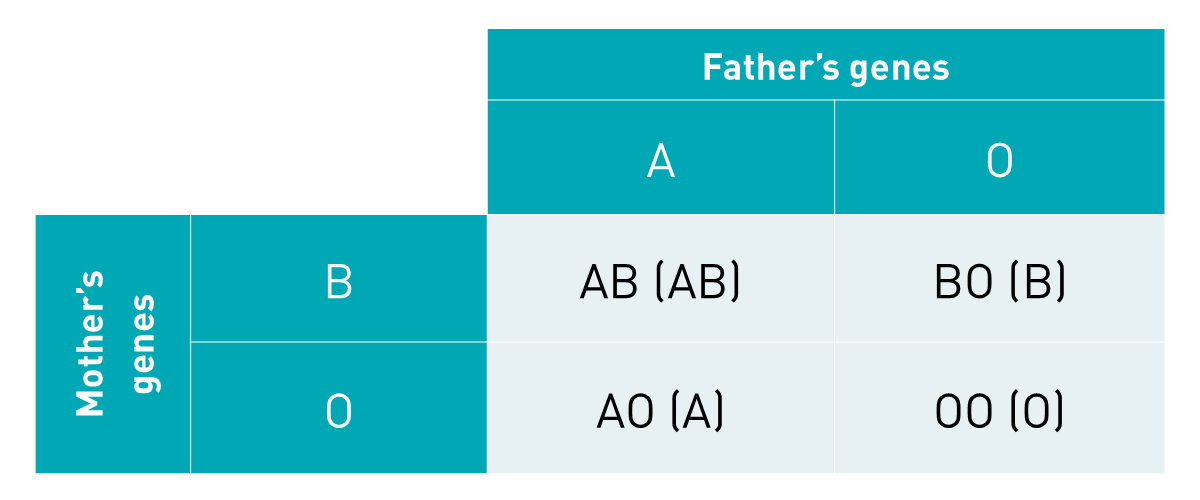
In this case, Hanna and her siblings have equal chance of being any of the four blood types.
My family is the opposite: my mom is AB+ and my dad is O+, so their genotypes were obvious before they had kids. AB is genetically heterozygous for both A and B genes (AB), and O is genetically homozygous by default (OO).
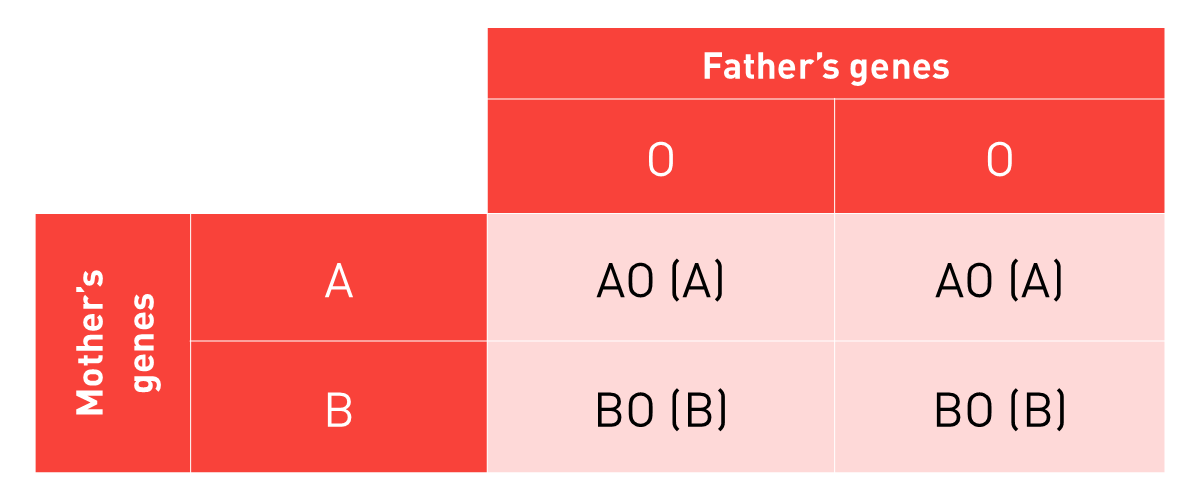
My brother and I, therefore, have a 50% chance of being Type A and a 50% chance of being Type B, but there is no way we could be Type O like Hanna.
Here’s the full range of possible outcomes by blood type:
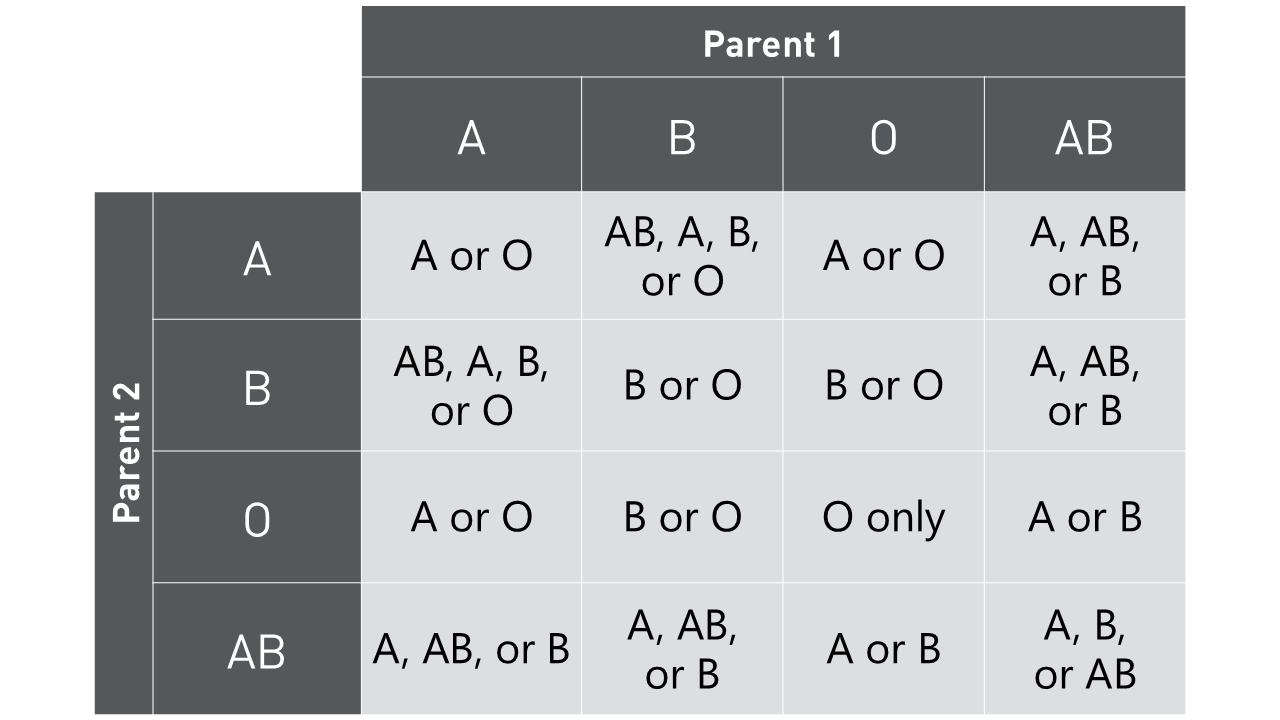
It’s therefore possible, and not uncommon, for everyone in a family to have a different blood type.
Rh type is a little easier: “Rh positive” refers to the presence of the RhD gene expressed on the red blood cell. You either have it or you don’t.
(This is the simple version – the Rh blood group family is actually very complex, with variations of D and dozens of other antigens!)
As an example, both parents in this table are Rh+ heterozygous:
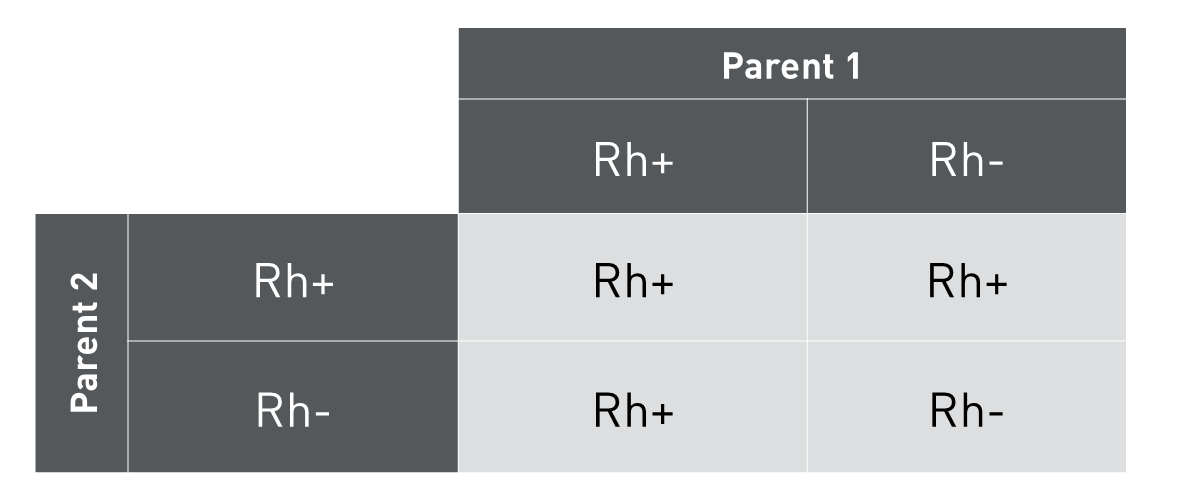
For these parents, there is a 75% likelihood that each child would be Rh positive and only a 25% chance that a child would be Rh negative.
Only about 15% of the US population is Rh- (and less than that in some parts of the world)!
Don’t know your blood type? We’ll tell you after your first donation. Better yet: bring the whole family – no Punnett’s squares needed.



Tell Us What You Think!